


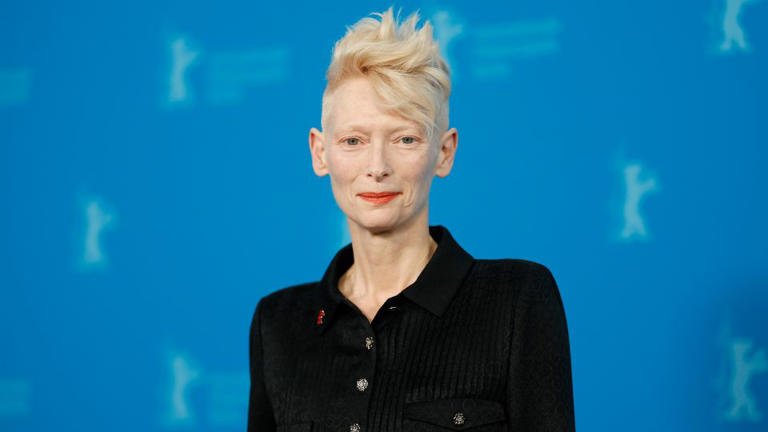
When people talk about actors who redefine what it means to perform Tilda Swinton inevitably rises to the top of the list. She is one of those rare artists who seems untouched by the usual rules of Hollywood. Her career feels more like a continuously evolving art project than a traditional path through fame. Swinton’s presence carries a quiet power—sometimes ethereal, sometimes unsettling, always unforgettable. Over the years, she has become a symbol of creative freedom, challenging ideas about gender, identity, and what an actor can be.
A Childhood Unlike Most
Born in London in 1960 as Katherine Matilda Swinton, she grew up in a Scottish family with a long, notable history. Yet despite coming from an aristocratic background, Swinton never felt especially connected to privilege. She often describes her school years as a time when she felt out of place, even lonely. She attended boarding school—Eton, famously—where she was a classmate of future King Charles III. But traditional institutions were never a natural fit for her curious, creative mind.
After school, she studied Social and Political Sciences at the University of Cambridge. While there, she found her way into acting almost by accident, first through student theatre. It wasn’t glamour that drew her in—it was the exploration of identity, the chance to step into different worlds, and the possibility of working with artistic rule-breakers.
A Creative Partnership That Shaped a Career
Swinton’s early career was shaped by her deep collaboration with experimental filmmaker Derek Jarman. He became one of her most influential creative partners and a defining force in her artistic life. With Jarman, she appeared in projects that pushed boundaries of form and storytelling—films like Caravaggio, The Last of England, and Edward II.
These were not mainstream movies, but they were powerful, daring works that helped Swinton develop her signature approach: fearless, unconventional, and deeply committed to artistic truth. Through Jarman, she also cemented her reputation as someone who would always choose an interesting challenge over a predictable role.
The Shape-Shifter Emerges
Tilda Swinton is perhaps best known for her transformative ability. Many actors can disappear into characters, but Swinton does it in a way that feels almost otherworldly. Her appearance—sharp, striking, and elegantly androgynous—has allowed her to embody roles that few actors could convincingly attempt.
Her breakthrough to international audiences came with Orlando (1992), based on Virginia Woolf’s novel. Playing a character who changes sex and lives across centuries, she delivered a performance that was daring, ahead of its time, and unforgettable. The film instantly made her a symbol of gender fluidity in cinema.
Over the next two decades, Swinton took on a staggering range of roles, each one entirely different from the last:
- In Michael Clayton (2007), she portrayed a ruthless corporate lawyer, a performance that earned her an Academy Award.
- In We Need to Talk About Kevin (2011), she delivered a raw, devastating portrayal of a mother facing the aftermath of an unthinkable tragedy.
- Her turn as a bizarre authoritarian official in Snowpiercer (2013) showed her gift for dark humor and bold physicality.
- As the Ancient One in Doctor Strange (2016), she brought a mystical, almost serene intensity to a major Marvel franchise.
Watching Swinton from film to film feels like watching a series of reinventions—each character shaped with precision and curiosity.
Collaborating with Film’s Most Visionary Directors
Swinton has worked with an impressive list of visionary filmmakers. Her ongoing collaborations with Wes Anderson—in films such as Moonrise Kingdom, The Grand Budapest Hotel, Isle of Dogs, and Asteroid City—highlight her playful, stylized side. She has also partnered with Bong Joon-ho, Jim Jarmusch, Luca Guadagnino, and the Coen Brothers, each time adapting her performance style to fit unique creative worlds.
One reason directors love working with her is her fearlessness. She brings a sense of artistic adventure, treating each role as a chance to explore something completely new.
More Than an Actor: An Artist at Heart
Swinton’s influence goes well beyond film. She has long been involved in live art installations and performance art. One of her most talked-about pieces involved her sleeping inside a glass box in a museum—an exploration of stillness, vulnerability, and presence.
She is also deeply embedded in the fashion world, admired for her bold, minimalist, often futuristic style. Designers like Haider Ackermann and brands like Chanel and Prada have embraced her as a muse who doesn’t just wear clothes but transforms them into statements.
Swinton herself treats fashion not as celebrity culture but as another avenue for creativity. Her red-carpet looks aren’t designed to impress so much as express.
A Quiet Life in Scotland
Despite her high-profile career, Swinton lives a remarkably grounded life in the Scottish Highlands. She raises family there, participates in local community art projects, and co-founded a local film festival. Her personal life reflects her values: simplicity, creativity, and a deep connection to place.
Why Tilda Swinton Matters
Tilda Swinton matters because she embodies artistic freedom. She reminds audiences that cinema can be wild, unconventional, and beautifully strange. She stands outside typical Hollywood expectations, proving that individuality is not a barrier to success but a pathway to it. Her work invites viewers to imagine beyond boundaries—to see identity not as a fixed box but an open field.
Swinton’s career is proof that choosing interesting work, taking risks, and staying true to one’s creative instincts can lead not only to success but to lasting cultural impact.
FAQs About Tilda Swinton
1. What is Tilda Swinton best known for?
She is best known for Orlando, Michael Clayton, We Need to Talk About Kevin, Snowpiercer, and Doctor Strange. Her androgynous style and daring performances have made her a modern icon.
2. Has Tilda Swinton won any major awards?
Yes, she won the 2008 Academy Award for Best Supporting Actress for Michael Clayton.
3. Why is Tilda Swinton considered androgynous?
Her facial structure, styling, and willingness to take on roles that challenge traditional gender expectations contribute to her androgynous, fluid image.
4. Where does she live?
She lives in the Scottish Highlands, where she enjoys a quiet lifestyle and supports local artistic projects.
5. Is she involved in fashion?
Absolutely. Swinton is widely admired as a fashion icon and collaborates with major designers known for bold, artistic styles.
