


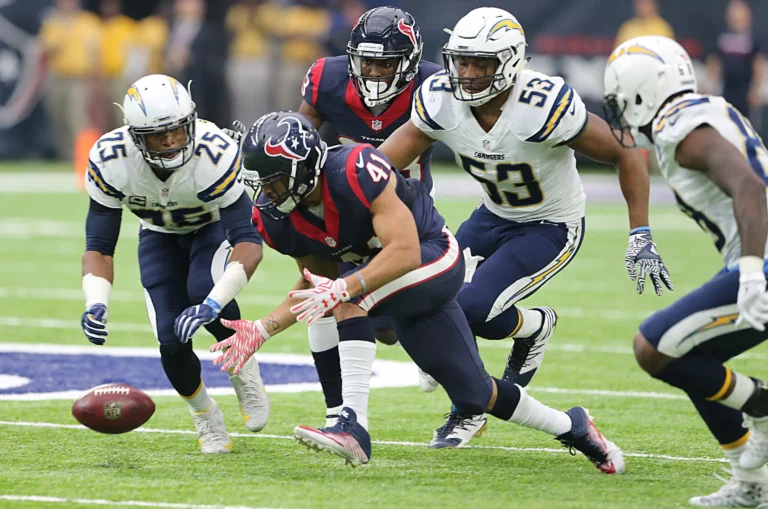
The playoff matchup between the Los Angeles Chargers and the Houston Texans ended in a decisive 32–12 victory for the Texans, leaving Chargers fans stunned. Houston’s performance was a textbook display of defensive dominance, efficient quarterback play, and opportunistic offense. This article breaks down the key player stats, turning points, and insights that defined the game.
Quarterback Showdown
Justin Herbert, the Chargers’ quarterback, struggled against a relentless Texans defense. Herbert completed 14 of 32 passes for 242 yards, managing one touchdown but throwing four interceptions. He was also sacked four times for a loss of 31 yards. These numbers highlight not only the Texans’ pressure but also the Chargers’ difficulty sustaining drives. Herbert’s passer rating for the game plummeted to roughly 40.9, reflecting a night where mistakes overwhelmed offensive production.
On the other side, C.J. Stroud of the Texans showcased composure and efficiency. He completed 22 of 33 passes for 282 yards, throwing one touchdown and one interception while being sacked three times. Stroud’s calm presence and accurate throws allowed Houston to maintain a balanced offense, mixing the pass and run effectively. His ability to avoid costly mistakes and distribute the ball to playmakers like Nico Collins made a crucial difference.
Running Game Analysis
The running game told a clear story. For Houston, Joe Mixon carried the ball 25 times, amassing 106 rushing yards and scoring a rushing touchdown. Mixon’s performance kept drives alive and allowed the Texans to control the clock, wearing down the Chargers’ defense. Houston’s ability to consistently gain yards on the ground complemented Stroud’s passing and made their offense difficult to defend.
The Chargers, however, failed to establish a running game. They totaled only 50 rushing yards, with J.K. Dobbins contributing 26 yards on nine carries, averaging just 2.9 yards per attempt. The lack of a consistent rushing threat forced Herbert into a pass-heavy game plan, which played right into Houston’s defensive strategy. Without the run game to open up play-action or keep the chains moving, the Chargers’ offense became predictable and vulnerable.
Top Receivers
For the Chargers, rookie Ladd McConkey emerged as a bright spot. He hauled in nine catches for 197 yards and one touchdown, including a spectacular 86-yard reception that showcased his speed and playmaking ability. Despite his individual success, the overall lack of support and turnovers overshadowed his efforts.
The Texans’ Nico Collins also had a standout performance, catching seven passes for 122 yards and a touchdown. His ability to create separation and secure critical catches helped Houston maintain momentum, particularly on scoring drives. Collins’ 122-yard performance set a Texans postseason record, underscoring his impact in high-stakes games.
Defensive Dominance
Houston’s defense was the defining factor in this matchup. They intercepted Herbert four times, including a pick-six by Eric Murray. Derek Stingley Jr. contributed two interceptions, effectively shutting down the Chargers’ top receiving options. The Texans’ pass rush constantly pressured Herbert, forcing hurried throws and limiting options. Their defensive efficiency converted turnovers into points and created a sense of urgency that the Chargers never overcame.
Special teams also played a role. The Chargers had an extra-point attempt blocked, which was returned by D’Angelo Ross for two defensive points. This unusual but momentum-shifting play further widened Houston’s lead and highlighted their all-around dominance.
Team Totals and Efficiency
The Texans outgained the Chargers in almost every statistical category. Total yards were 429 for Houston versus 261 for Los Angeles. Third-down conversion rates were 36% for the Texans and only 27% for the Chargers, reflecting sustained drives by Houston and struggles for Los Angeles. On average, the Texans gained 6.1 yards per play, compared to 4.8 yards per play for the Chargers. Houston also controlled possession, holding the ball for 34 minutes and 25 seconds, while the Chargers only had 25 minutes and 35 seconds.
These statistics reveal the broader story: Houston controlled the pace of the game, limited mistakes, and capitalized on every Chargers miscue. Los Angeles, despite flashes of brilliance from McConkey, was never able to find rhythm or sustain drives.
Turning Points
The pivotal moments all favored the Texans. Herbert’s four interceptions dramatically shifted momentum, with one returned for a touchdown. The blocked extra point turned into defensive points for Houston. Mixon’s consistent rushing and Stroud’s calm, accurate passing helped sustain drives, while Houston’s defense kept Los Angeles off balance. These moments compounded to create a scenario where the Chargers never recovered.
FAQs (Frequently Asked Questions)
Q: Who was the standout player in this game?
A: While several players had notable performances, Nico Collins and Joe Mixon for Houston, along with rookie Ladd McConkey for the Chargers, stood out. Collins set a Texans playoff record for receiving yards, Mixon dominated the run game, and McConkey had a breakout performance despite the loss.
Q: Why did the Chargers struggle offensively?
A: The Chargers faced relentless defensive pressure, had four interceptions thrown by Herbert, and failed to establish a consistent run game. These factors combined to stall drives and limit scoring opportunities.
Q: How did Houston’s defense impact the game?
A: Houston’s defense forced turnovers, applied constant quarterback pressure, and created scoring opportunities through a pick-six and blocked PAT return. The secondary, led by Derek Stingley Jr., shut down key receivers and dictated the game’s pace.
Q: Was special teams a factor in the outcome?
A: Yes, the blocked extra point returned for two points by D’Angelo Ross added to Houston’s lead and shifted momentum further in their favor.
Q: Could the Chargers have done anything differently?
A: Establishing a more effective run game and reducing turnovers would have been critical. Protecting Herbert from Houston’s pass rush might have opened up passing lanes and allowed their offensive weapons to contribute more consistently.
Conclusion
The Chargers vs Texans playoff matchup was a game defined by Houston’s all-around dominance. They combined a disciplined defense, a controlled rushing attack, and timely passing to dictate the tempo and outcome. While the Chargers had moments of individual brilliance, particularly from Ladd McConkey, the team as a whole was undone by turnovers, pressure, and inability to sustain drives. Houston’s victory was a statement of strategic execution, highlighting the importance of balance and opportunism in playoff football.
