


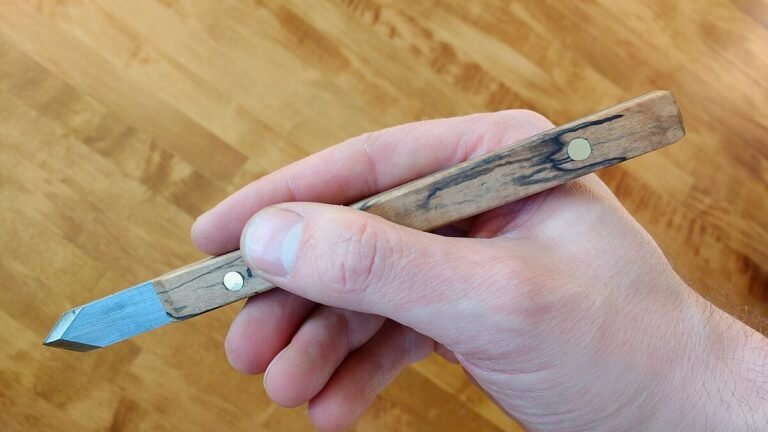
In woodworking, precision is everything. Even the smallest error can turn a perfect piece into a misfit. This is where a marking knife comes in. Unlike pencils or pens, a marking knife creates crisp, clean lines that guide your cuts and ensure perfect joinery. If you are a woodworker, whether amateur or professional, understanding the marking knife and its uses can elevate your craftsmanship.
What is a Marking Knife?
A marking knife is a hand tool used in woodworking to score or mark wood before cutting, chiseling, or joining. Unlike a pencil that leaves a broad and often imprecise line, a marking knife creates a fine groove. This groove acts as a visual guide and also helps to prevent tear-out when cutting across the wood grain. Most marking knives have a sharp, angled blade and a handle made from wood, plastic, or metal for comfortable grip.
Types of Marking Knives
Marking knives come in several types, each suited for specific tasks:
- Single-bevel marking knife – The most common type, with a bevel on one side, ideal for precise joint marking.
- Double-bevel marking knife – Beveled on both sides, suitable for marking lines in either direction.
- Scorp knife – Often used for carving or detailed joinery, offering extra control for fine work.
The blade’s shape and sharpness are crucial. A dull blade may crush fibers instead of cutting them, leading to inaccurate lines.
Benefits of Using a Marking Knife
- Precision: It creates a fine groove that ensures accurate cuts and joints.
- Clean Work: Reduces wood tear-out, especially when working across the grain.
- Guided Chiseling: Makes chiseling easier by providing a defined path.
- Professional Finish: Gives woodworking projects a more polished, high-quality look.
Using a marking knife may require some practice, but the improvement in accuracy and finish is immediately noticeable.
How to Use a Marking Knife
- Select the Right Knife – Choose a single or double-bevel knife based on the project.
- Secure the Wood – Clamp your workpiece to prevent movement.
- Position a Straightedge – Align a ruler or square where you want the line.
- Score the Wood – Hold the knife like a pen and lightly cut along the straightedge.
- Check the Groove – Ensure the line is deep enough to guide cutting tools but not too deep to damage the wood.
Remember, the knife should move steadily and confidently. Hesitation can lead to uneven lines.
Maintenance Tips
To keep your marking knife in optimal condition:
- Sharpen Regularly – Use a fine sharpening stone to maintain a sharp edge.
- Clean After Use – Remove wood particles and dust to prevent blade corrosion.
- Store Safely – Use a sheath or blade guard to protect both the blade and your hands.
Proper maintenance ensures your marking knife lasts for years and performs consistently.
FAQs About Marking Knife
Q1: Can I use a pencil instead of a marking knife?
A pencil works for general marking, but it lacks precision. A marking knife produces a fine, consistent groove that improves joint accuracy and reduces tear-out.
Q2: Which wood types need a marking knife the most?
Hardwoods like oak, maple, or walnut benefit greatly because the knife helps prevent splintering during cuts. Softwoods can be marked with a knife too, but pencils may suffice for rough work.
Q3: What is the difference between a single-bevel and double-bevel marking knife?
A single-bevel knife has one beveled side, allowing it to cut clean lines against a square edge, ideal for joinery. A double-bevel knife is beveled on both sides, offering versatility in direction but slightly less precision.
Q4: How deep should the groove be?
The groove should be just deep enough to guide your saw or chisel. Typically, a light score of 0.5–1 mm is sufficient; going deeper risks splitting the wood unnecessarily.
Q5: Can I use a marking knife for metal or other materials?
No, marking knives are designed specifically for wood. For metals, you need tools like scribers or metal marking pens.
Q6: How do I sharpen a marking knife?
Use a fine sharpening stone or diamond stone. Hold the bevel against the stone at the correct angle (usually 20–25°) and use light, even strokes until the edge is razor-sharp.
Q7: Are marking knives expensive?
Prices range from affordable entry-level knives to high-end professional tools. Even a budget knife is better than a pencil for joinery accuracy, while premium knives offer better ergonomics and longer-lasting edges.
Conclusion
A marking knife may seem like a simple tool, but it has a significant impact on woodworking precision. It guides cuts, prevents tear-out, and elevates the quality of your projects. For woodworkers aiming for accuracy and professional results, mastering the marking knife is essential.
Investing time in learning its proper use and maintenance will reward you with cleaner lines, tighter joints, and more satisfying craftsmanship. Whether you are making furniture, cabinets, or fine wood projects, the marking knife is a small tool that makes a big difference.
