


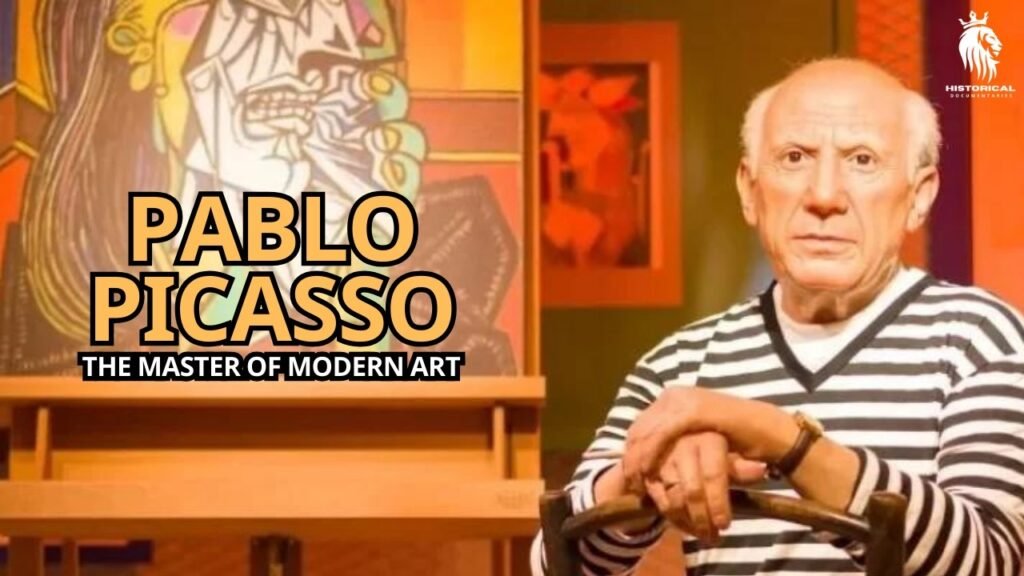
Pablo Picasso is one of the few names in art history that almost everyone recognizes. More than a painter, he was a force of nature—an artist who didn’t just create but redefined what art could be. His work stretched across painting, sculpture, ceramics, printmaking, and stage design, leaving a legacy that still shapes the art world today.
Early Life and First Steps in Art
Picasso was born in Málaga, Spain, in 1881. His father was an art teacher, and it didn’t take long for people to see that Pablo had extraordinary talent. By the time he was a teenager, he was outpacing his instructors and pushing boundaries.
His early works were grounded in realism, but he soon began experimenting, searching for new ways to express the world around him. This search would define his career.
Blue and Rose Periods
Artists often pass through phases, but with Picasso, these shifts became movements. Between 1901 and 1904, he entered his Blue Period, painting somber, emotional works dominated by shades of blue. These reflected themes of poverty, isolation, and human suffering.
Then came the Rose Period (1904–1906), where his art softened. Warmer colors, circus performers, and more optimistic tones appeared. Together, these periods showed Picasso’s ability to capture the depth of human emotion in very different ways.
Cubism: Breaking the Rules
Perhaps Picasso’s biggest contribution to art was Cubism, which he developed with Georges Braque around 1907. Instead of showing a subject from one angle, Cubism broke objects into geometric shapes and reassembled them to show multiple perspectives at once.
His painting “Les Demoiselles d’Avignon” shocked audiences with its sharp, fractured style. What seemed chaotic at the time opened the door to modern abstract art.
War, Protest, and “Guernica”
Picasso lived through both World Wars, and these experiences shaped his art. His most famous political work, “Guernica” (1937), was a response to the bombing of the Basque town during the Spanish Civil War.
The massive black-and-white mural is raw and unsettling, depicting the horrors of war without glorification. It remains one of the most powerful anti-war statements in art history.
Endless Reinvention
Unlike many artists who settle into a single style, Picasso kept evolving. From neoclassicism to surrealism, he constantly explored new ideas. He once said, “It took me four years to paint like Raphael, but a lifetime to paint like a child.”
That childlike curiosity drove him to experiment until the end of his life. He produced an estimated 50,000 works, a staggering output that reflects his relentless drive to create.
Later Life and Legacy
Picasso spent much of his later life in France, continuing to paint, sculpt, and inspire. He died in 1973 at the age of 91, leaving behind not just artworks, but a completely new way of thinking about creativity.
Today, his pieces hang in the world’s greatest museums, from the Museo Picasso in Barcelona to the Museum of Modern Art in New York. His name has become synonymous with innovation.
FAQs About Pablo Picasso
1. What is Pablo Picasso most famous for?
Picasso is best known for pioneering Cubism and creating revolutionary works like Les Demoiselles d’Avignon and Guernica.
2. How many artworks did Picasso create?
He produced an estimated 50,000 works, including paintings, drawings, ceramics, and sculptures.
3. Why did Picasso go through different art periods?
Picasso constantly reinvented his style to explore new forms of expression. The Blue and Rose Periods, Cubism, and Surrealism each reflected different moments in his life and artistic vision.
4. What is the meaning of “Guernica”?
Guernica is a protest painting showing the suffering caused by the bombing of the town of Guernica during the Spanish Civil War. It’s one of the most famous anti-war artworks ever created.
5. Did Picasso only paint?
No. Picasso was also a sculptor, ceramicist, printmaker, and stage designer. His creativity touched nearly every corner of the art world.
6. How did Picasso influence modern art?
By breaking away from traditional perspectives and creating new visual languages like Cubism, Picasso inspired countless artists and reshaped how we think about art.
7. Where can I see Picasso’s work today?
Major collections are found at the Museo Picasso (Barcelona and Málaga), Musée Picasso (Paris), and the Museum of Modern Art (New York).
Final Word
Pablo Picasso was not just an artist—he was a movement in himself. From emotional portraits to revolutionary abstractions, his art captured both the personal and the political. His relentless experimentation reminds us that creativity has no limits, and that true art often comes from breaking the rules.
Word Count: ~822
