


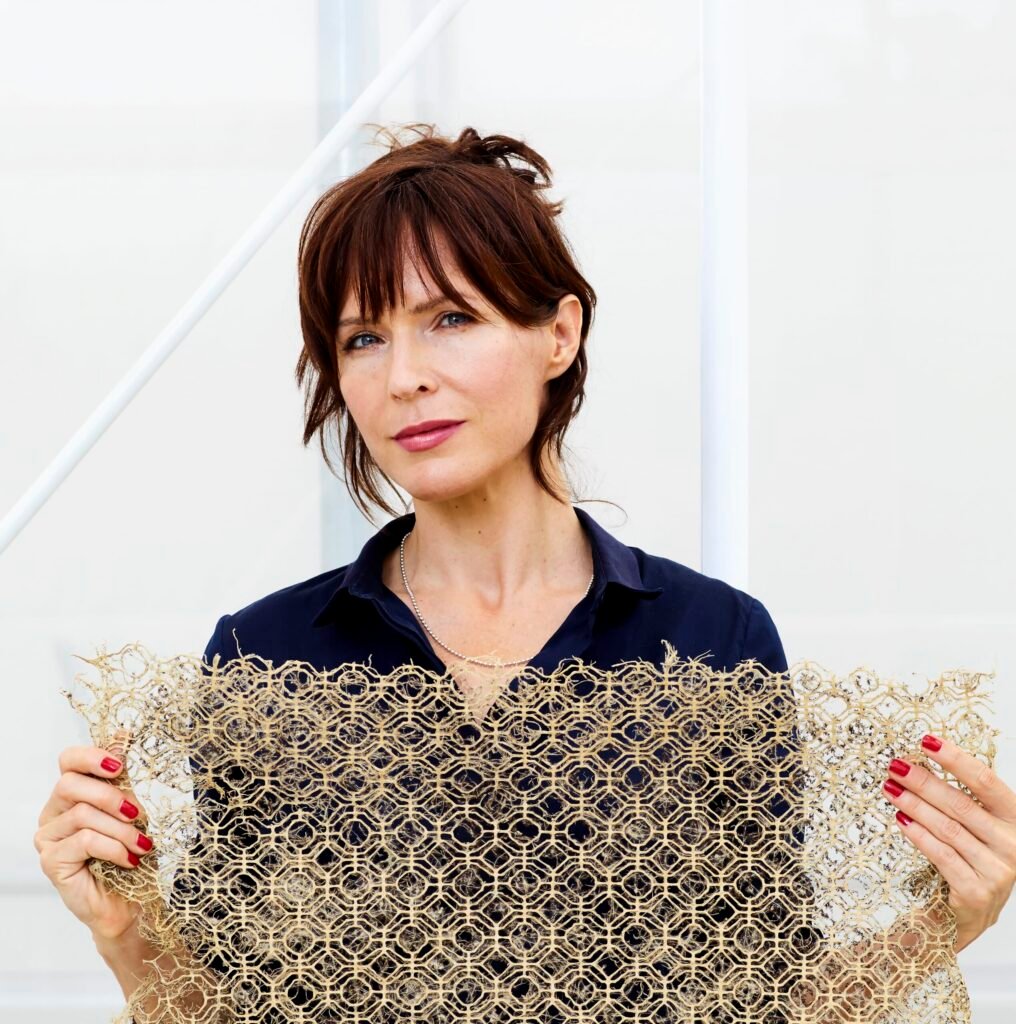
German artist Diana Scherer has found a way to transform plant roots into textiles that resemble delicate lace. Her work combines art, science, and design, creating living fabrics that blur the boundary between natural growth and human craft.
What makes her approach unique is that she doesn’t weave fibers by hand. Instead, she collaborates with nature itself, guiding roots to form intricate, lace-like patterns underground.
How It All Began
Scherer’s fascination with roots started when she noticed the complexity of a root-bound plant removed from a pot. The underground structures seemed like an invisible language of nature. From that curiosity grew years of experimentation with botanists, biologists, and designers.
She discovered that grasses—like oats and wheat—were especially suited for her method because their roots grow densely and flexibly. By combining her artistic vision with biological research, she developed a process she calls “plant root weaving.”
The Technique
The process is both scientific and artistic. Seeds are planted in soil containing geometric templates—grids, honeycomb patterns, or cellular structures. As the plants grow, their roots respond to gravity, moisture, and available space. They weave themselves along the templates, producing delicate networks that mimic lace or textiles.
When the soil is removed, the roots reveal their intricate shapes. Each piece is unique—part controlled design, part natural improvisation. Scherer often compares the process to collaborating with a living partner: she sets the framework, but the plants ultimately decide the final form.
Beyond Fragility
Though they look fragile, the root-based textiles are surprisingly strong. Once dried and carefully preserved, they hold together with a paper-like durability. Some are framed as artworks, while others are displayed as textile samples. The contrast between their delicate appearance and unexpected strength is part of their appeal.
Exhibitions and Recognition
Scherer’s work has been exhibited in major international museums and design events. Her “plant-root lace” has appeared at the Victoria & Albert Museum in London, the Biennale of Sydney, and Dutch museums such as Museum Kranenburgh.
Audiences are often struck not only by the beauty of the pieces but by the concept: textiles grown instead of manufactured. Her art suggests alternative futures for materials—ones where sustainability and collaboration with natural processes replace industrial extraction.
Publications
In 2023, Scherer released a book titled Interwoven: Exercises in Root-System Domestication. The publication includes photographs of her works, essays from scientists and designers, and reflections on the cultural meaning of her process. The book highlights the philosophical side of her practice: questioning how humans interact with plants and whether we can see them as partners rather than resources.
FAQ
1. How does Diana Scherer grow lace from roots?
She plants seeds in soil filled with specially designed templates. As the roots grow, they follow these guides, forming lace-like patterns that are revealed when the soil is removed.
2. What plants does she use?
Mostly grasses such as oats and wheat. These species develop dense, flexible root systems that can be guided into textile-like structures.
3. Are the works fragile?
They appear delicate, but once dried and stabilized they are surprisingly durable, similar in resilience to paper art.
4. Where can her work be seen?
Her plant-root textiles have been shown internationally, including in London, Sydney, and throughout the Netherlands. She continues to exhibit widely in art and design contexts.
5. Has she written about her process?
Yes. Her book Interwoven: Exercises in Root-System Domestication documents the method, the philosophy behind it, and contributions from other thinkers in art and science.
6. What is the deeper meaning of her work?
Beyond creating beautiful lace patterns, Scherer’s art challenges us to rethink our relationship with nature. It shows plants not as passive materials, but as active collaborators with their own intelligence and agency.
Final Thoughts
Diana Scherer’s plant-roots lace is more than a visual spectacle. It’s a dialogue between human intention and natural growth, an experiment that transforms roots into fabric while transforming our perspective on nature. Her work asks us to consider: what if the textiles of the future could be grown, not manufactured?
